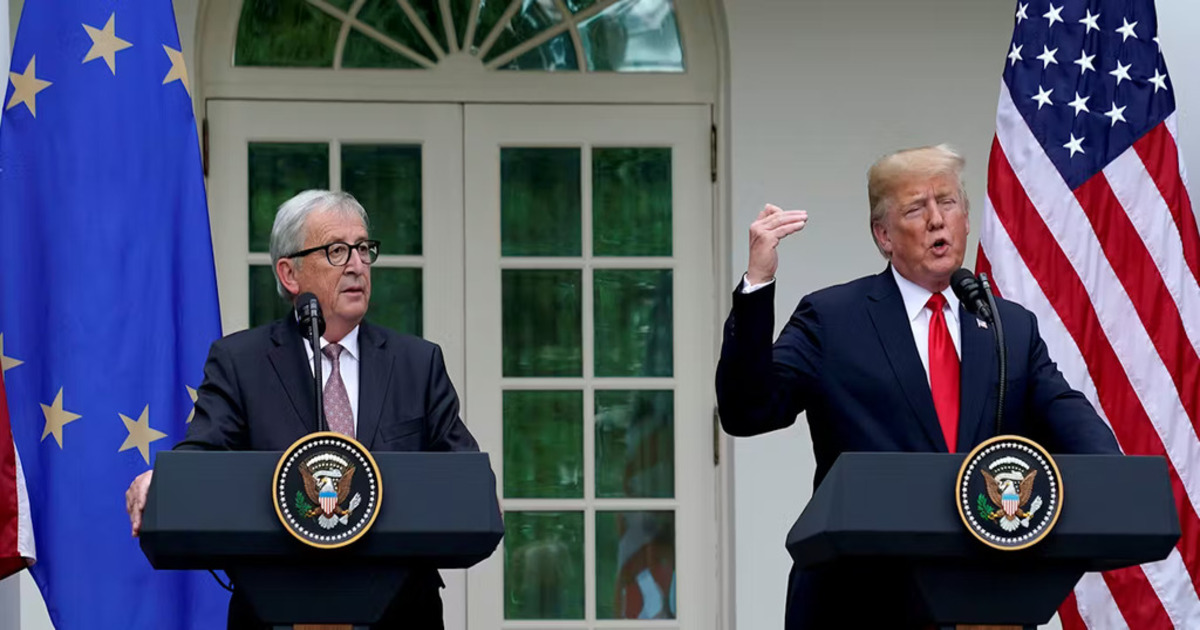

The relationship between former U.S. President Donald Trump and the European Union (EU) has been marked by tension and controversy. Trump’s critical stance on the EU and his bold remarks about its creation have drawn both concern and backlash from European leaders, highlighting a significant shift in transatlantic relations during his presidency.
Trump’s Views on the EU’s Formation
Donald Trump has repeatedly expressed his skepticism about the European Union, going as far as to claim that the bloc was created to harm the United States economically. In a striking comment, he stated, “Let’s be honest — the European Union was formed to screw the United States. That was their purpose, and they’ve done it very well, but now I’m president.” These remarks shocked many, given that the U.S. had historically supported European integration as a means to promote stability and prevent future conflicts in the post-World War II era.
Trump’s perspective suggests a view of international relations rooted in economic competition rather than cooperation. He has often portrayed trade relationships as zero-sum games, where one side’s gain is the other side’s loss. This view placed the EU — a major trading partner of the U.S. — in his crosshairs.
Economic Tensions and Tariffs
One of the most contentious aspects of Trump’s relationship with the EU was his administration’s trade policy. In 2018, Trump imposed tariffs on European steel and aluminum, citing national security concerns. The EU responded with retaliatory tariffs on American goods, escalating fears of a full-blown trade war.
In 2025, Trump further announced plans to impose a 25% tariff on European car imports, a move that was seen as a direct attack on Germany’s powerful automotive industry. Trump justified the tariffs by arguing that the U.S. had a significant trade deficit with the EU and that these measures were necessary to protect American jobs and industries.
European leaders, including then-President of the European Council Donald Tusk and Spanish Prime Minister Pedro Sánchez, strongly condemned Trump’s actions and rhetoric. They emphasized that the EU’s creation was rooted in fostering peace, economic collaboration, and mutual growth, not in undermining the United States.
Diplomatic Fallout
Beyond trade disputes, Trump’s dismissive attitude toward key EU institutions and leaders deepened the rift. He publicly praised Brexit, encouraged other nations to reconsider their EU membership, and showed greater enthusiasm for bilateral deals with individual European nations rather than engaging with the EU as a unified entity.
The diplomatic fallout from Trump’s anti-EU stance was evident in strained summits and frosty public exchanges. European leaders increasingly viewed Trump’s America as an unreliable ally, prompting calls for greater European strategic autonomy, especially in areas such as defense and technology.
Looking Ahead
While Trump’s presidency ended in 2021, the scars left on EU-U.S. relations have not fully healed. His combative approach forced Europe to rethink its dependency on American leadership and pushed for a more independent foreign policy stance. As global dynamics continue to shift, the future of transatlantic relations will depend on both sides finding common ground and rebuilding trust.
In conclusion, Donald Trump’s critical view of the EU and his aggressive trade policies created significant turbulence in EU-U.S. relations. His comments about the EU’s formation as an anti-American project not only strained diplomatic ties but also reshaped how Europe perceives its partnership with the United States. Moving forward, the challenge will be to bridge the divide and reinforce cooperation in the face of shared global challenges.


