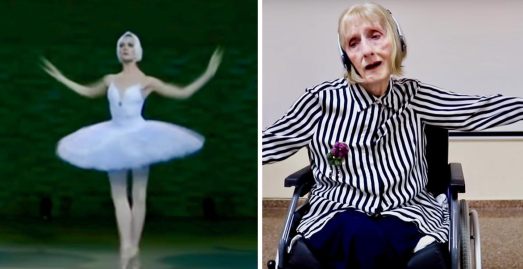
The footage makes for a heartbreakingly beautiful clip that, in less than two weeks since it was uploaded, has racked up more than a million views on YouTube alone.
The video was also shared by famous actor Antonio Banderas and posted to Twitter on Monday.
“The emotional power of music!” The actor wrote in Spanish, his mother tongue.
The video prompted many to take to social media and share their own experiences of watching a loved one with dementia or Alzheimer’s light up after listening to music.
Seth Darby, an Australian Twitter user, wrote: “My dad is now non-verbal due to Alzheimer’s but the last time I was able to visit him he still lit up and said the lyrics to the Beatles song I played.”
“It was incredibly moving,” wrote fellow American Twitter user Jon Johnson. “He embodies the breathtaking beauty of humanity struggling against the onslaught of time.”
According to NPR, not much is known about Gonzalez’s past life. The Asociación Música para Despertar claims that she was a prima ballerina in New York City in the 1960s, although this information has since been disputed. Her story has become an urban mystery among social media users. Alastair Macaulay, a dance critic who wrote for The New York Times, makes it his mission to get to the heart of Gonzalez’s story. He posted updates regarding his investigation on Instagram, with a surprise posted on Tuesday.
Macaulay claimed to have found a document dating from 1966, apparently sealed by Cuban authorities. The document stated that the “High School of Professional Studies, Nueva York” was to be awarded the title of “ballerina” at Ballet de las Americas to “Marta C. Gonzalez Saldana”. According to NPR, there is no “High School for Professional Studies, Nueva York” in the United States.
McCauley also discovered that the images of the young ballerina in the video were not of Gonzalez, as many viewers assumed, but rather of former Russian ballerina Ulyana Lopatkina. Additionally, Lopatkina performs a number called Dying Swan, to a piece of music called Carnival of the Animals, by French composer Camille Saint-Saëns – not Swan Lake.


