

A young boy named Collin and his parents, Stephanie and Dillon, were thrust into a living nightmare. Collin had always been a vibrant and healthy child, spending his days exploring and playing with his brother. But one day, while the two were playing, Collin took a nasty fall and hit his head. Despite seeming unaffected, things took a turn for the worse overnight.
The next morning, Collin was unable to move and experienced difficulty breathing and swallowing. His parents rushed him to the hospital, initially believing his symptoms were due to the fall. However, doctors discovered there was no brain injury and warned the family that Collin’s condition could quickly take a turn for the worse.

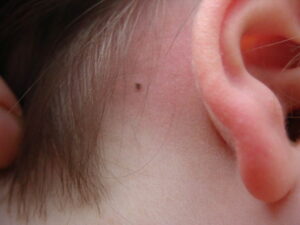
Feeling helpless, the doctors transferred Collin to a children’s hospital where a team of specialists thoroughly examined him. It was then that they found the cause of his sudden decline: a tick nestled behind his ear.
Collin was transferred to a children’s hospital in a bigger city, where a team of specialists, including neurologists and infectious disease experts, carefully examined him. They discovered a tick behind the child’s ear, which they promptly removed. Collin began to recover his balance, and gradually all the symptoms he had begun to disappear.
Dr. Travis Stork, who treated Collin’s case, explained that tick bites are common and that their saliva contains a neurotoxin that triggers a reaction in the human body, causing paralysis. The paralysis starts in the legs and gradually progresses upward in what is known as ascending paralysis.
This paralyzing neurotoxin enters the bloodstream while the tick feeds, leading to the patient’s inability to move. Typically, the symptoms start to subside about three minutes after removing the tick.
Once the tick was removed, Collin gradually regained his balance and all his symptoms started disappearing. Dr. Travis Stork, who treated Collin, clarified that tick bites are quite common and their saliva triggers a reaction in the human body that results in paralysis.

The saliva contains a neurotoxin that enters the bloodstream when the tick feeds, causing ascending paralysis, which starts from the legs and leads to complete immobility. Fortunately, the symptoms usually begin to disappear within three minutes of tick removal.
Collin has now fully recovered and returned to his normal self, but his parents will never forget the fear they experienced when they discovered their previously healthy child paralyzed the next day.


